Image credit: Source: DraftKings SEC filings.
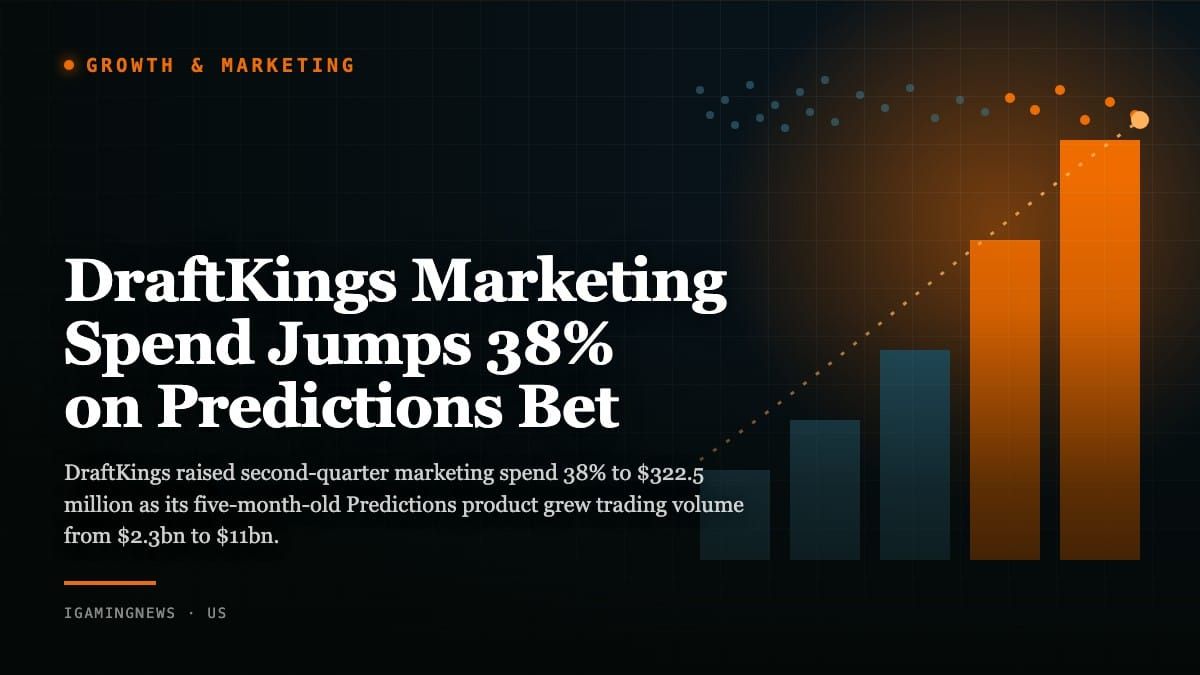
DraftKings raised sales and marketing spend 38% year over year to $322.5 million in the second quarter of 2026, chasing growth in its five-month-old Predictions product. The company reported the increase in an SEC filing on August 6, alongside total revenue of $1.44 billion, down 4.8% from a year earlier.
The spending surge is buying scale fast. Predictions, DraftKings' prediction-markets product launched December 19, 2025, grew annualized trading volume from $2.3 billion in April to $11 billion in July, chief executive Jason Robins told analysts on the August 7 earnings call. More than 600,000 customers have used it so far this year.
Why the marketing line moved
DraftKings' Monthly Unique Payers rose about 9% to 3.6 million, while average revenue per payer fell 13% to $132, which the company attributed to bettor-friendly game outcomes and new customer promotions. Sports betting handle reached $13.1 billion, up 14.5% from a year earlier. Adjusted EBITDA fell sharply to roughly $115 million from $300.6 million in the same quarter last year, a drop the company tied directly to the Predictions investment.
Chief Financial Officer Alan Ellingson said the core sportsbook and casino business "remains on track to generate approximately $1 billion of Adjusted EBITDA this year, providing us with financial flexibility to invest behind the significant opportunity that we are seeing in Predictions." DraftKings kept its full-year guidance at $6.5 billion to $6.9 billion in revenue and $700 million to $900 million in Adjusted EBITDA.
The acquisition math behind the number
DraftKings said it landed roughly 30% more customers than planned in the quarter while spending only about 10% more than budgeted on acquisition, meaning per-customer costs ran about 25% below expectations. That efficiency is what lets the marketing line jump 38% without blowing through full-year guidance: the company is buying more customers per dollar than it forecast, then reinvesting the savings into Predictions volume.
Predictions also gives DraftKings a foothold in states where sports betting remains illegal, since the product operates as a federally regulated exchange rather than a state-licensed sportsbook. Robins framed the strategy around the NFL season starting in September, telling analysts the company's "advantaged LTV position" and "playbook to innovate on a leading Predictions offering" underpin its confidence heading into football's biggest quarter.
The next quarter tests the trade
DraftKings is spending like a company defending a category it does not yet fully own. Whether the marketing surge converts into durable Predictions share, rather than a one-quarter volume spike ahead of the NFL season, is the number to watch when DraftKings reports Q3.
Related: Prediction Markets Have Become Sports Betting's Rival | Sportsbook Promotional Spending Hits the Tax Wall | Loyalty Programs Are Replacing Free Bets in US Betting | iGaming Acquisition Shifts From CPA to Revenue Share