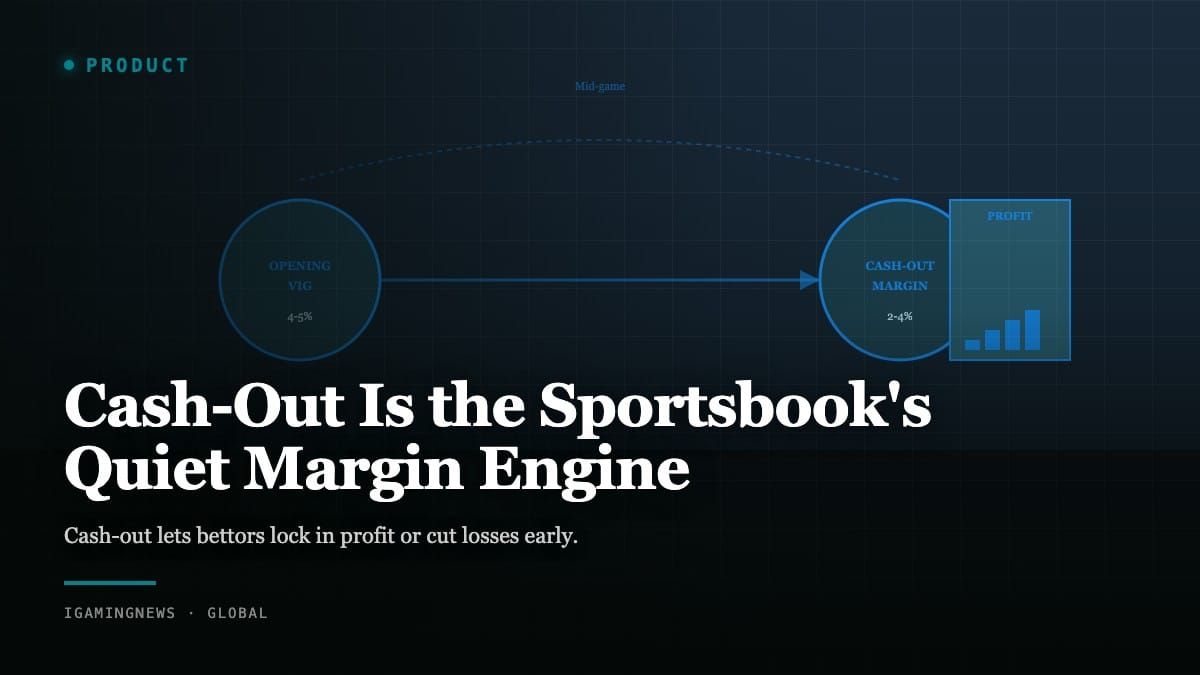
Cash-out is a sportsbook product feature that appears to give bettors control (the ability to settle a bet before the game ends) but it is actually a margin mechanism that lets the operator extract a second vigorish. Most operators have the feature but few have optimized the pricing model. It is leaving money on the table.
How cash-out works
A bettor places a $100 bet on the Lakers at +130 (implied probability 43%, payout $230 if they win). At halftime, the Lakers are up 15 points. Their implied win probability has risen to, say, 75% (payout if held to end: $275).
The sportsbook's cash-out offer: $200.
The bettor now faces a choice: - Hold until end (expected value: $275 × 75% + $0 × 25% = $206.25) - Cash out now (certain value: $200)
Rationally, the bettor should hold. But most bettors do not think in expected-value terms. They cash out because they dislike volatility. The sportsbook books the $15 difference between the fair value ($206.25) and the cash-out price ($200) as margin.
The two-margin structure
A sportsbook's cash-out profit comes from two sources:
-
The opening vigorish: When the bettor places the $100 bet, the sportsbook has already priced the odds to expect ~4-5% margin. (If a 50-50 game, odds should be -110/-110; if they quote -110/-110 on both sides of every game, they make ~5% per side.) This margin is structural and collects regardless of whether cash-out is used.
-
The cash-out margin: When the bettor cashes out mid-game, the sportsbook is trading out of its position (it has hedging exposure from other bettors) and capturing a second spread. The cash-out price is typically 2-4 percentage points lower than the fair mid-market value. This is margin #2.
For a typical sportsbook accepting $10m in daily volume with 5% of bets taking cash-out:
- Daily cash-out volume: $500k
- Average cash-out margin: 2.5 points
- Daily cash-out profit: $12.5k
- Annual cash-out margin: $4.6m (against $3.65bn annual volume)
For a $500m annual GGR operator, that is roughly 1.3% of total sportsbook margin. For operators with high cash-out utilization (25-35% of bettors), it can reach 3-5% of sportsbook margin.
Why operators under-monetize it
Most cash-out offers are rule-based, not dynamic:
- Fixed offer: "You can cash out for 70% of your potential payout until 30 seconds before the game ends."
- Dynamic, but coarse: "Cash-out value updates every 10 seconds based on live odds."
This is not optimization. It is a feature checkbox.
Advanced operators (DraftKings, BetMGM, FanDuel; the Tier 1 US sportsbooks) have moved to dynamic, real-time cash-out pricing:
- Cash-out offer updates every 1-2 seconds, reflecting live movement in the underlying market (Sportradar odds, exchange spreads).
- Pricing model adjusts the margin based on player value (VIP players get tighter margins; recreational players get wider margins).
- A/B tests run continuously on margin widths. If increasing the margin from 2% to 3% reduces cash-out utilization by 15%, the ROI test determines which is optimal.
Advanced models also segment on game type: - Parlays: wider cash-out margin (4-6%) because volatility and value swings are high. The bettor values certainty more. - Single-game bets: tighter margin (1.5-2.5%) because the odds move less. - Live bets (in-game): wider margin (3-5%) because the value is uncertain until close to finish time.
The result: DraftKings reports cash-out now accounts for 2-3% of gross margin on its sportsbook book. FanDuel reports similar numbers. Both note they are still optimizing; static-margin competitors are likely leaving 0.5-1.5 points of cash-out margin uncaptured annually.
The bettor perspective
For bettors, cash-out is a volatility hedge they should use sparingly.
The math is simple: cash-out is profitable for the sportsbook because bettors systematically overpay for the optionality. A bettor who cashes out a +200 parlay for $180 (when fair value is $215) is paying $35 for the privilege of avoiding risk. That is a luxury tax.
Bettors who profit long-term do: - Use cash-out on large accumulators (where variance is highest and the hedge has real value) - Avoid cash-out on single bets and tight parlays - Understand that the sportsbook's offered price is always against them
Professional bettors have long treated cash-out as a "bettor's trap." Recreational bettors mostly use it to avoid watching a game sweat out, which is a valid use case but an economically poor one.
The product race
Cash-out is now a table-stake feature in competitive markets (US, UK, Australia). The differentiation is moving to:
- Breadth: Can you cash out a 6-leg parlay with mixed sports + live bets? (Yes for Tier 1 operators; no for many mid-market books.)
- Speed: How fast does the offer update? (DraftKings: 1-2 seconds; industry average: 10-30 seconds)
- Transparency: Can the bettor see the mid-market fair value alongside the cash-out offer? (FanDuel recently added this; most do not)
Operators investing in real-time cash-out pricing are gaining 0.3-0.8 points of margin annually. Over a $1bn sportsbook book, that is $3m-$8m per year in incremental profit. The feature feels like a concession to players (they get to lock in profit). The business truth is the opposite.
Cash-out is a product feature that looks like a bettor concession but operates as a margin mechanism. Operators who optimize it, win.