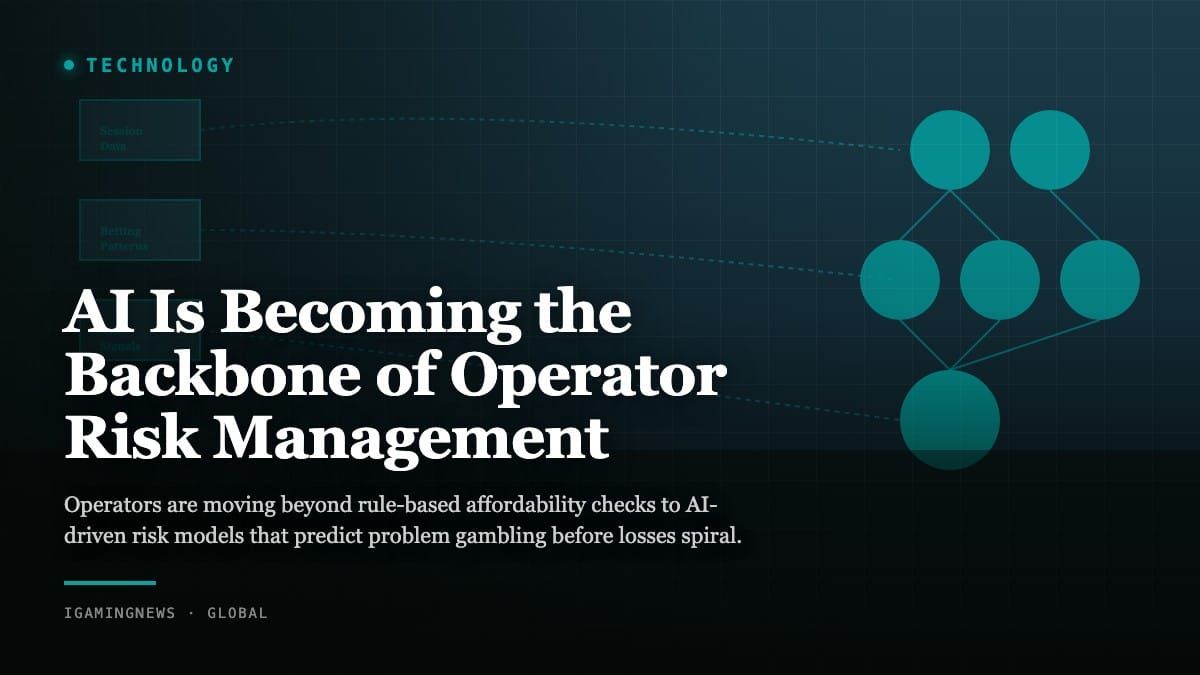
The affordability check is the floor. AI risk prediction is the ceiling. While regulators mandate deposit limits and loss notifications, forward operators are building predictive models that flag at-risk players 30-60 days before they hit regulatory thresholds.
The shift from reactive to predictive
Traditional responsible-gambling tools are reactive: a bettor hits a loss threshold, a system sends a notification, compliance logs it. The intervention happens after harm accumulation has already started.
AI-driven systems are predictive. They ingest session data, betting patterns, deposit frequency, time-of-day activity, game selection, and multi-session coherence, then flag a player who exhibits a risk profile (not a loss amount) for early intervention. A player might trigger an AI alert at £200 cumulative loss, when a rule-based system would still be silent.
The vendors building this stack are primarily three:
-
Optimove-Smartico (merged 2024, now the largest iGaming CRM + risk suite): uses a Bayesian network on session microdata and past-user cohort clustering to estimate player-churn-to-problem-gambling probability. Deployed at Evoke, Kindred, and three largest Brazilian operators.
-
SAS Risk Orchestration Suite: rule-based, but allows continuous custom-model injection via SAS Viya (their open model platform). Used by three Tier 1 suppliers (Evolution's prediction engine, Kambi's pricing risk models) and deployed at Flutter and Entain.
-
Palantir Foundry (iGaming module): incoming. Palantir announced an iGaming vertical integration in Q3 2026 targeting the "operator data mesh" (consolidating PAM, sportsbook, casino, finance into one query layer). Early beta with three Tier 1 operators (not named; confidentiality locked through 2027).
What operators are actually building in-house
Medium-tier and smaller operators cannot afford Optimove's £500k-year licensing. They are building with open-stack tools:
- Kafka event stream → bet settlement → account-level aggregation
- Python Scikit-learn models trained on historical cohort loss curves + churn data from their own player base
- Airflow orchestration to score all active players every 24 hours
- Webhook notification into CRM to queue interventions
Cost to build: £300k-£600k initial, £80k-£150k/year to run. Deployment time: 6-12 months for a legacy operator, 4-6 weeks for a greenfield platform.
The accuracy variance is massive: Optimove reports 78-82% precision on problem-gambling risk detection in-sample; internal operator builds report 55-68% (high false-positive rate, which drives over-intervention and bettor friction).
The regulatory question: is prediction compliance?
The UKGC's 2026 affordability framework is explicit: "the operator must notify when cumulative net loss exceeds £500." It does not mandate predictive intervention.
But the LCCP's underlying principle is "effective player protection," and several operators have argued in private with the Commission that predictive intervention is more effective than reactive affordability checks. The UKGC has not formally ruled. This is a live regulatory ambiguity.
Germany's GlueStV contains no language on prediction at all; it only sets bet ceilings and loss aggregation. A German operator using AI risk prediction complies anyway because the rule-based limits are still in place.
Brazil's Decree 11,034 (2022) stipulated the responsible-gambling framework but left implementation details to individual states. São Paulo (SEESP) now permits (and three operators are using) predictive AI alerts alongside mandatory limits. Rio Grande do Sul (FGI) has not addressed it yet.
The operator economics
An operator running AI risk prediction + the regulatory affordability-check stack is adding 15-30% to the compliance overhead:
| Component | Annual cost | Operator headcount |
|---|---|---|
| Affordability checks (rules + notification) | £150k-£300k | 3-5 |
| AI risk model (licensing or in-house) | £200k-£600k | 2-4 |
| Interventionist staff (additional chat / review capacity) | £400k-£800k | 8-12 |
| Total | £750k-£1.7m | 13-21 |
Operators with sub-£100m GGR report this is unsustainable. Operators with £1bn+ GGR view it as rounding in risk & compliance.
This is creating a market-structure shift: small operators are exiting or consolidating into aggregators. Aggregators can amortize the AI stack across 50-200 operators and charge it back at £2-5 per operator per month. The economics flip.
Where the real play is
The operators winning on this front are not the ones building the best AI models. They are the ones integrating prediction into the player experience non-punitively:
- Earned incentives: When an AI alert fires for an at-risk player, offer a marginal-value trade (e.g., free-bet bonus) if they complete a 15-minute affordability check. This converts a compliance friction point into a retention opportunity.
- Tiered interventions: First alert = notification only. Second alert (within 30 days) = require account review. Third alert = auto-limit to a lower deposit threshold. This gives the player two chances to self-correct.
- Transparent scoring: Show the player their risk score (0-100) and the factors driving it. Transparency reduces friction and builds trust in an inherently paternalistic system.
Operators running this playbook report 40-55% of at-risk players accept the review and set their own stricter limits without regulatory intervention. The player chooses. Compliance is covered. Retention survives.
Regulatory compliance is a table-stake. Predictive AI that keeps players in control while protecting them is the competitive edge.