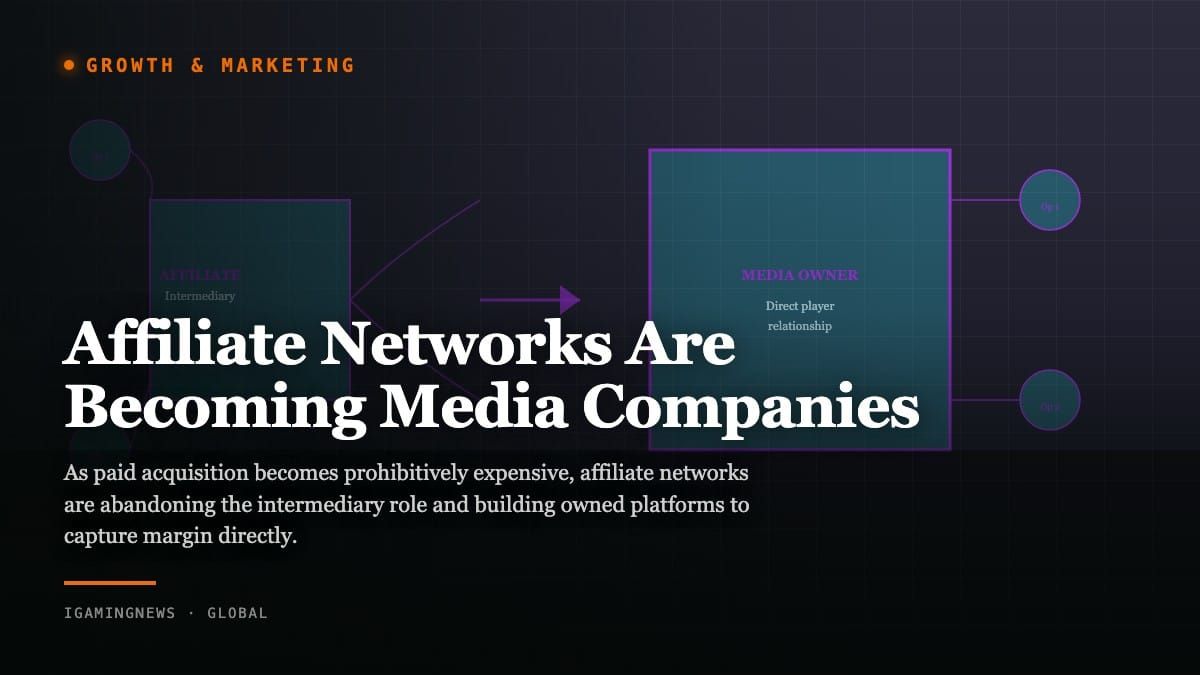
The traditional iGaming affiliate model is collapsing under paid-acquisition economics. Better Collective, Catena Media, and Gambling.com Group, the three Tier 1 affiliate networks, have all announced a simultaneous shift: they are moving from earning referral fees on traffic they direct to operators, to owning the customer relationship themselves and selling risk to operators wholesale.
The math that broke the model
Traditional affiliate economics:
- Affiliate publishes review or odds comparison → bettor clicks → lands on operator site → operator confirms the affiliate ID → payout: 25-35% of first-week player losses, or 5-15% of lifetime revenue share.
The model worked when customer acquisition cost (CAC) via Google Search was £3-8 per player. Today:
- Google's core SEO traffic to affiliate review sites is down 40-60% since the AI Overview rollout (June 2023 → October 2026).
- Paid search (Google Ads) now costs £12-35 per click for iGaming keywords in competitive markets (US, UK, Australia).
- Social (Meta, TikTok) iGaming-keyword advertising is banned in 12+ countries and heavily restricted in others.
- Affiliate payment networks (Tradetracker, Tune, Impact) charge 15-25% of payout for transaction settlement and fraud detection.
A Tier 1 affiliate network like Better Collective pays: - £5-12/player to acquire traffic (now SEM-heavy, not organic) - 5-7 points of take to payment network - 25-35% of player losses to pass to operators - Cost of goods sold: £18-40 per player per affiliate referring an operator
If an operator bought that traffic directly via affiliate payout (CPA), their cost would be £18-40. If the affiliate's own margin on that player was 1-3 points, the affiliate earned £0.50-1.20 per player.
At scale (Better Collective drives ~50m player referrals/year), that margin is untenable. Worse, when organic SEO traffic declined 50%, affiliates had to shift budget to paid channels, which immediately crushed margins further.
The strategic pivot: become the operator
All three Tier 1 networks announced in 2025-2026:
Better Collective: Launched "Playbook," a direct-to-player sports betting and casino free-to-play platform with real-money ramp-on for qualified players, white-labeled for operators. Better Collective owns the player data, the engagement loop, and the funnel. Operators buy players as a wholesale risk, not a referral fee.
Catena Media: Divested owned-media brands (AskGamblers to GiG, Financer to private equity) and shifted to a "marketplace" model. Catena now operates the affiliate supply side (publishers generating traffic) and sells conversion-guaranteed packages to operators: "1,000 active players with 55% monthly retention" for £80-120k/month. Catena owns the SLA.
Gambling.com Group: Rebranded to "Grandstand" in 2026 and spun out "Draft," a free-to-play prediction game (daily fantasy, pick'em) where winners can convert winnings to real-money play at partner operators. Same mechanic: direct relationship with the player, operators buy conversion at wholesale.
All three are abandoning the affiliate fee model. They are becoming media companies that own the player funnel and sell guaranteed conversion volume to operators.
Why operators will accept this
From an operator's perspective, the pivot is attractive:
- Certainty: "1,000 players with 55% retention" is more predictable than "we'll send you traffic and hope it sticks."
- Margin: Wholesale player packages at £80-150/player are lower CAC than the affiliate model's £25-40 equivalent.
- Responsibility: The affiliate-turned-media-company owns fraud, chargebacks, and quality. The operator gets vetted players.
Operators like Flutter, Entain, and DraftKings have all signed pilot deals with Playbook and Draft, effectively saying: "Yes, we'll buy players this way."
The casualty: pure-play affiliates
Tier 2 and Tier 3 affiliate publishers (individual review sites, odds scrapers, niche communities) are in trouble. If the Tier 1 networks have shifted to wholesale media, they have no large buyer. Operators will not negotiate a 25-35% referral fee with a small publisher when Playbook offers 55% retention at £100/player.
Consolidation is accelerating. Affiliates with £1m-£10m annual GGR are either:
- Selling to a Tier 1 network (valuation: 2-4x EBITDA, gutted by declining traffic)
- Pivoting to niche owned-media (e.g., a Discord community of poker players, monetized as a player supply to poker operators directly)
- Exiting entirely (founder payout from liquidation; market has rotated out)
What this means for growth budgets
The shift breaks down into two tiers:
Tier 1 operators (£1bn+ GGR) can negotiate directly with Better Collective, Catena, and Grandstand as wholesale supplier partners. This compresses CAC to £80-120/player and locks in quality through SLAs.
Mid-market operators (£50m-£500m GGR) face a purchasing desert: Tier 1 networks are no longer selling referrals, and independent publishers are fragmented. Mid-market operators are now either building owned-media properties (newsletters, Discord communities) themselves or paying a 20-30% premium to smaller affiliate networks that still operate on commission.
This is a form of stratification. Tier 1 operators get wholesale efficiency. Everyone else pays more and gets less.
The age of the independent affiliate marketer is ending. The age of the integrated affiliate-media operator is beginning.