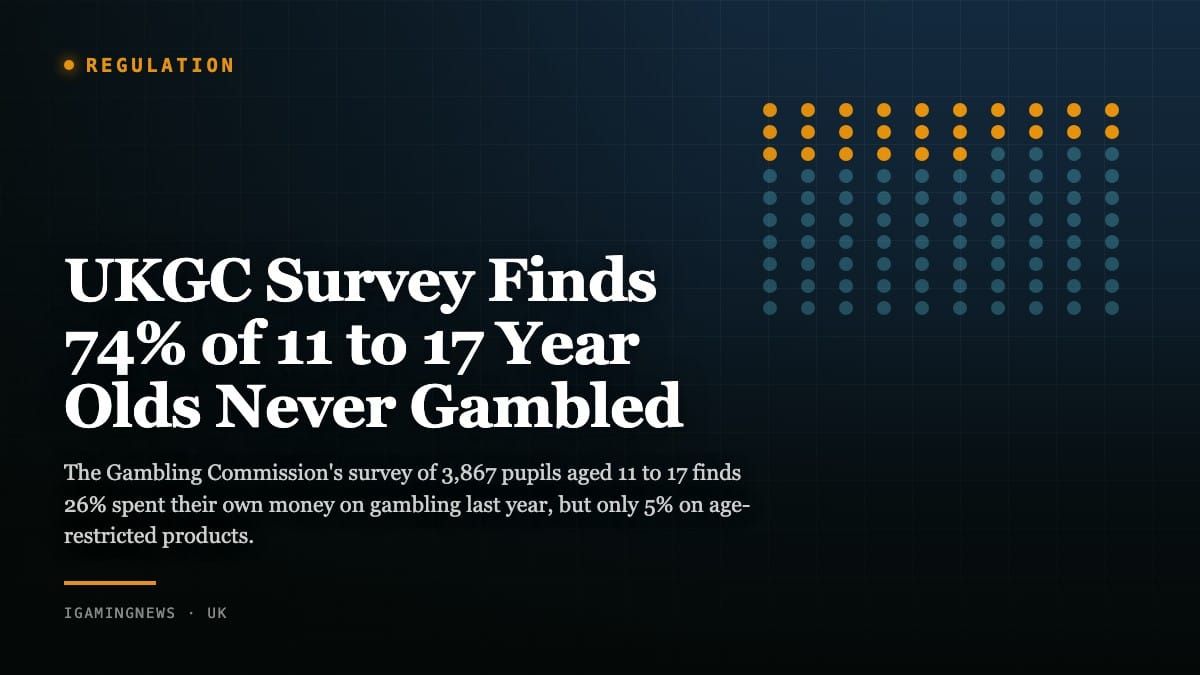
Cover illustration by the editorial desk. Not a photograph of any school or child.
The Gambling Commission's annual survey found 74% of 11 to 17 year olds said they had never gambled, a statistically significant rise from 69.6% a year earlier.
The Young People and Gambling Report 2026, published on 12 November, surveyed 3,867 pupils through an online questionnaire completed in class at schools in England, Scotland and Wales. The Commission runs the survey every year to guide regulatory action and to inform how it protects children from gambling harm.
Spending is narrower than participation
The report says 26% of 11 to 17 year olds spent their own money on gambling in the last year. Most of that spending was on legal activities or on products that are not age-restricted. Only 5% reported spending their own money on age-restricted gambling products.
That split matters for policy. Operators must keep children away from age-restricted products such as betting shop bets and online casino games. Most of the youth spending the survey captures falls outside that control:
- Arcade machines such as penny pushers and claw grabs: 19%
- Bets for money between friends or family: 11%
- Card games for money with friends or family: 5%
The Commission notes that a number of gambling activities are legal or not restricted for this age group, which is why the report tracks them separately.
Harm indicators barely moved
Only 0.9% of respondents reported negative consequences of gambling, such as missing school, lying to friends or family, or spending dinner money on gambling. Last year the figure was 1.2%. The Commission says the change is not statistically significant.
A decline since 2022, with variation between years
Across the annual surveys from 2022 to 2026, the share of young people who had gambled in the last 12 months fell from 50% to 45%. The share who spent their own money fell from 31% to 26%. The Commission describes an overall decline with variation from year to year.
Where age checks stop
The Commission's requirements on operators target age-restricted products. The activities that dominate youth spending in this survey, such as arcade prizes and cash bets between friends, sit largely outside that perimeter. The headline figures are shares of respondents, not sums of money, so the report shows where the gap sits but cannot size it.
The report also looks at exposure to advertising, including on social media, and at the relationship between gambling and gaming. Those findings sit in the full report.
What the survey cannot show
The findings rely on self-reported answers, and the Commission says they should be read as estimates of what young people report rather than verified measures of their activity. Ben Haden, the Commission's Director of Research and Statistics, said the survey "provides one perspective" on the question of protecting young people.
For an operator or regulator reading the data, the useful caution is about scope. A declining participation figure is good news on its own terms, but the most common youth activity in the survey sits outside the age-restricted products the Commission's rules cover.