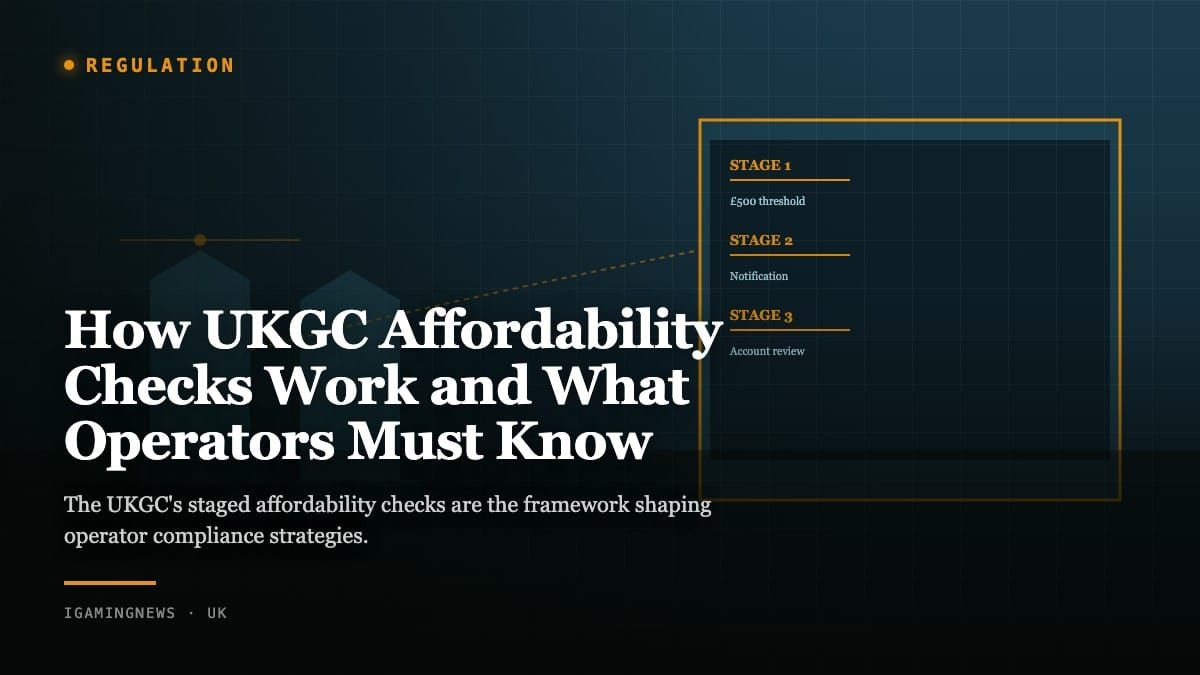
The UKGC's affordability check framework is not a ban. It's a staged intervention system designed to catch problem spending patterns before they escalate. Understanding how it works is now essential for any operator targeting UK players.
What the UKGC framework does
The framework applies three deposit-threshold checks, spaced 60 days apart:
- Day 0: A bettor opens an account. No intervention unless they explicitly ask for limits.
- Day 60: If cumulative net losses exceed £500, the operator sends a mandatory notification and offers deposit-limit tools.
- Day 120: If cumulative net losses exceed £2,000 since the first trigger, the operator must offer a mandatory account review.
This is not the pilot's older "net-loss test" that tracked individual decision points. This is continuous monitoring tied to account age. The shift from decision-point intervention to time-gated snapshots changes operator data architecture and CRM timing.
Compliance costs operators face
| Layer | Implementation | Operator cost | |---|---|---|- | Detection | Continuous net-loss calculation | Real-time ledger writes; 0.5-2ms added to bet settlement | | Notification | Triggered email + in-product | Template, dispatch, CRM integration; ~£50-200k initial, £10-30k/year SaaS licensing | | Account review | Mandatory 30-min conversation or self-service questionnaire | Live-chat staffing or chatbot training; 20-50% of flagged accounts accept review | | Documentation | Mandatory record of offer and response | Audit trail in customer files; ~100 basis points on compliance team headcount |
Operators running legacy PAMs that do not track net-loss in real time face a two-tier choice: build the feature in-house (12-18 months, £500k-£1.5m) or migrate to a turnkey PAM (Kambi, Genius GTS, GiG CoreX) that has the plumbing built in (4-8 weeks, £250k-£500k migration).
The enforcement signal
The UKGC began random post-audit reviews of operator affordability-check records in Q2 2026. Operators who do not document the offers, or whose threshold calculations lag by more than 2 hours, face £5m-£10m fine windows per the 2025 Licence Conditions and Code of Practice (LCCP).
This is real enforcement, not guidance. The rule is live.
What it means for different players
For operators: Affordability checks are now a load-bearing part of your product. They cannot be silenced. The £100k-£500k spend is the table stakes.
For affiliates: Affiliate links now carry implicit compliance liability. If your referred bettor hits the £500 threshold within 60 days, the operator has a duty to send that notification. Affiliates flagged as directing high-loss cohorts may see operators tighten referral limits. Better Collective and Catena Media have already restructured onboarding to surface affordability intent early.
For bettors: The notification at £500 cumulative net loss is your signal that your behaviour is being tracked. The mandatory account review at £2,000 is not punitive; it is a safeguard. Taking it is how you prove you are in control.
Where this stands in the global framework
The UK's affordability-check framework is now the toughest player-protection gate in the Western world. Germany's GlueStV caps bets at EUR5 per spin but does not track multi-day loss patterns. Spain requires deposit limits but does not enforce affordability reviews. The UKGC's three-trigger, time-gated system is the model no other regulator has matched in scope or enforcement rigour.
Brazil, which launched regulated iGaming in May 2024, borrowed the deposit-limit concept but paired it with a weaker "aims to protect" notification standard. Operators report Brazil's implementation is compliance theatre: the data flows but intervention is rare.
The US state-by-state approach is even lighter. Only Pennsylvania and Massachusetts have affordability-adjacent rules, and both are deposit-limit-only, with no net-loss tracking.
The UKGC's lead here matters. It sets the regulatory floor that multinational operators now use as the global minimum. If you run affordability checks for the UK, you are running them everywhere.
The framework is live, enforcement is real, and the operator cost is non-negotiable. Plan accordingly.