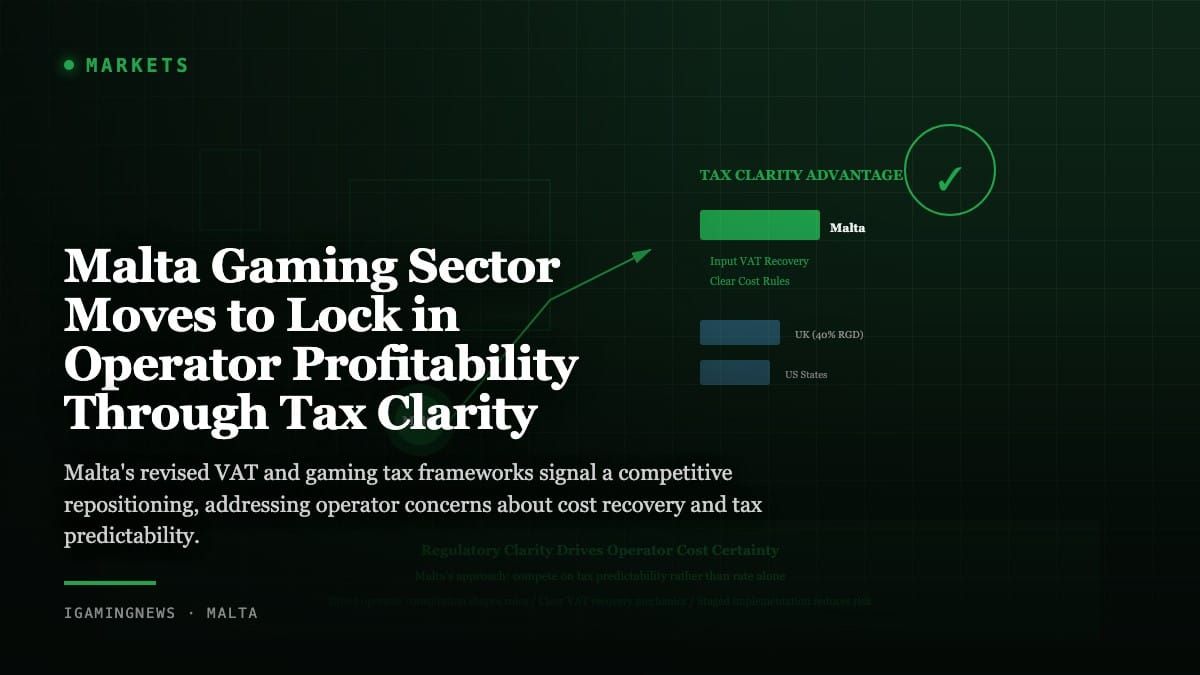
Malta has revised its VAT and gaming tax frameworks to provide clearer cost-recovery rules and predictable tax treatment of B2B gaming services, a signal that the island is competing hard to retain operators facing higher tax burdens elsewhere. The changes take effect 1 October 2026 as part of the Government's broader commitment to safeguard the sector's long-term competitiveness.
The revised VAT framework clarifies the treatment of sports betting and casino offerings and opens recovery of eligible input VAT costs. This addresses a standing operator pain point: unclear deductibility rules that required case-by-case interpretation and exposed operators to tax audits and recalculation risk. Input VAT recovery directly improves operator cost structures and profitability.
Malta's gaming sector is material to the economy. The MGA's 2025 statistics show the sector handling €12bn in operator turnover and €3.2bn in consumer deposits. Over 6,000 people work in gaming directly. Tax clarity is essential to retain major operators who can license in competing jurisdictions.
Competing jurisdictions have tightened profitability through tax increases: the UK's Remote Gaming Duty jumped to 40% in April 2026, and US states impose escalating tax rates on sportsbooks and casinos. Malta's approach is the inverse: use tax clarity and favorable cost-recovery rules to make profitability predictable and attractive relative to higher-tax jurisdictions. An operator comparing Malta to the UK or US increasingly factors in total cost of compliance and tax certainty alongside raw tax rates.
The consultation process included direct engagement with gaming operators and industry bodies, suggesting the final rules reflect operator input. This approach differs from tax-driven regulatory capture; it is instead regulatory clarity designed to compete on clarity rather than on rate alone.
The timing coincides with intensified competition for operator licensing activity. Brazil, Colombia, and other emerging markets are opening or revising their frameworks. Malta's move to lock in clarity is a defensive play to retain incumbent operators and attract those evaluating geographic footprint expansion.