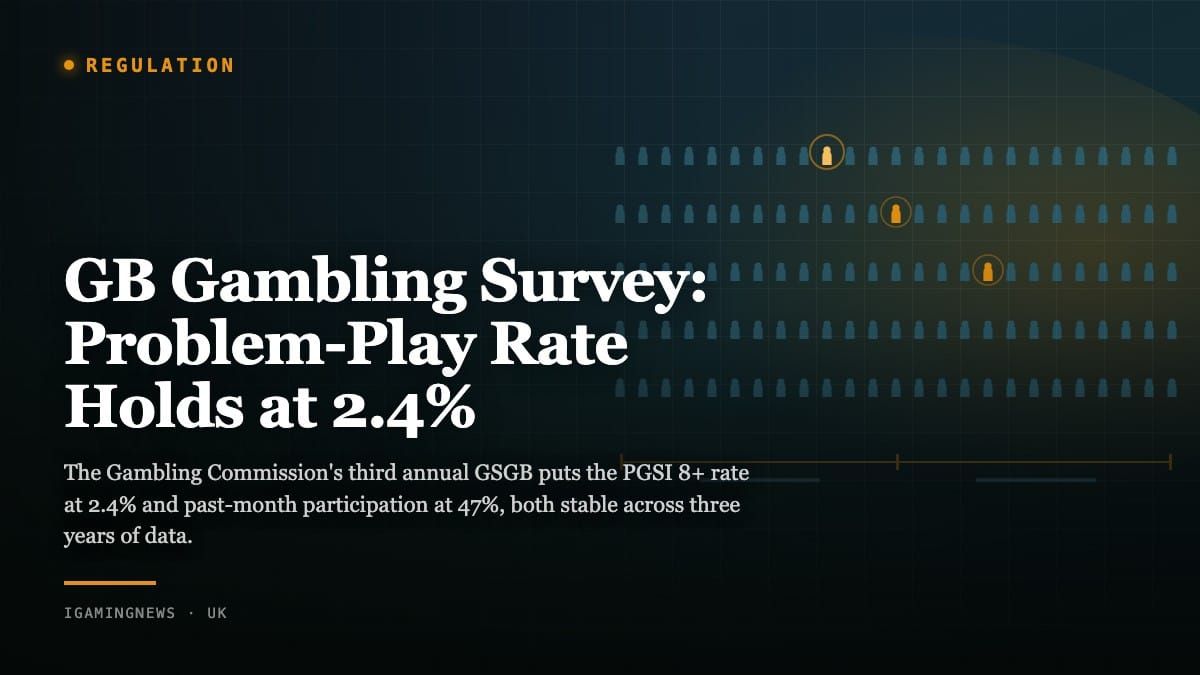
The share of British adults gambling at a problem level held at 2.4% in the Gambling Commission's third annual Gambling Survey for Great Britain, published on 16 July 2026. That figure, a PGSI score of 8 or more, has stayed flat across all three years of the survey.
The GSGB is now the Commission's primary source of gambling behaviour data. It draws on roughly 20,000 adults aged 18 and over each year, run by the National Centre for Social Research with the University of Glasgow, under an independently reviewed method. Three consecutive years, covering 2023 to 2025, give the regulator its first run of directly comparable data.
Headline participation was also stable. In 2025, 47% of adults said they had gambled in some form in the previous four weeks. Stripping out people who only played the National Lottery brings that to 27%.
On motivation, 84% of gamblers cited the chance of winning big money, 69% pointed to fun, 57% to making money, and 53% to excitement. Attitudes skewed benign: 78% reported positive or neutral feelings about their own gambling.
"Three years of GSGB provides a richer, more timely picture of gambling trends than previously available," said Tim Miller, the Commission's Executive Director for Research and Policy.
The stability cuts two ways for the industry. Operators will read a flat 2.4% as evidence that a tightening regime, including financial risk checks on bettors, has not moved harm in either direction. Campaigners will argue the same number shows the measures are not yet reducing harm. Either way, the survey now sets the empirical baseline against which future rule changes get judged, so the methodology itself will stay contested.
For suppliers and operators, the practical takeaway is that policy arguments in Great Britain increasingly turn on GSGB numbers. Getting familiar with how the survey defines and measures harm is no longer optional for anyone lobbying on future regulation.